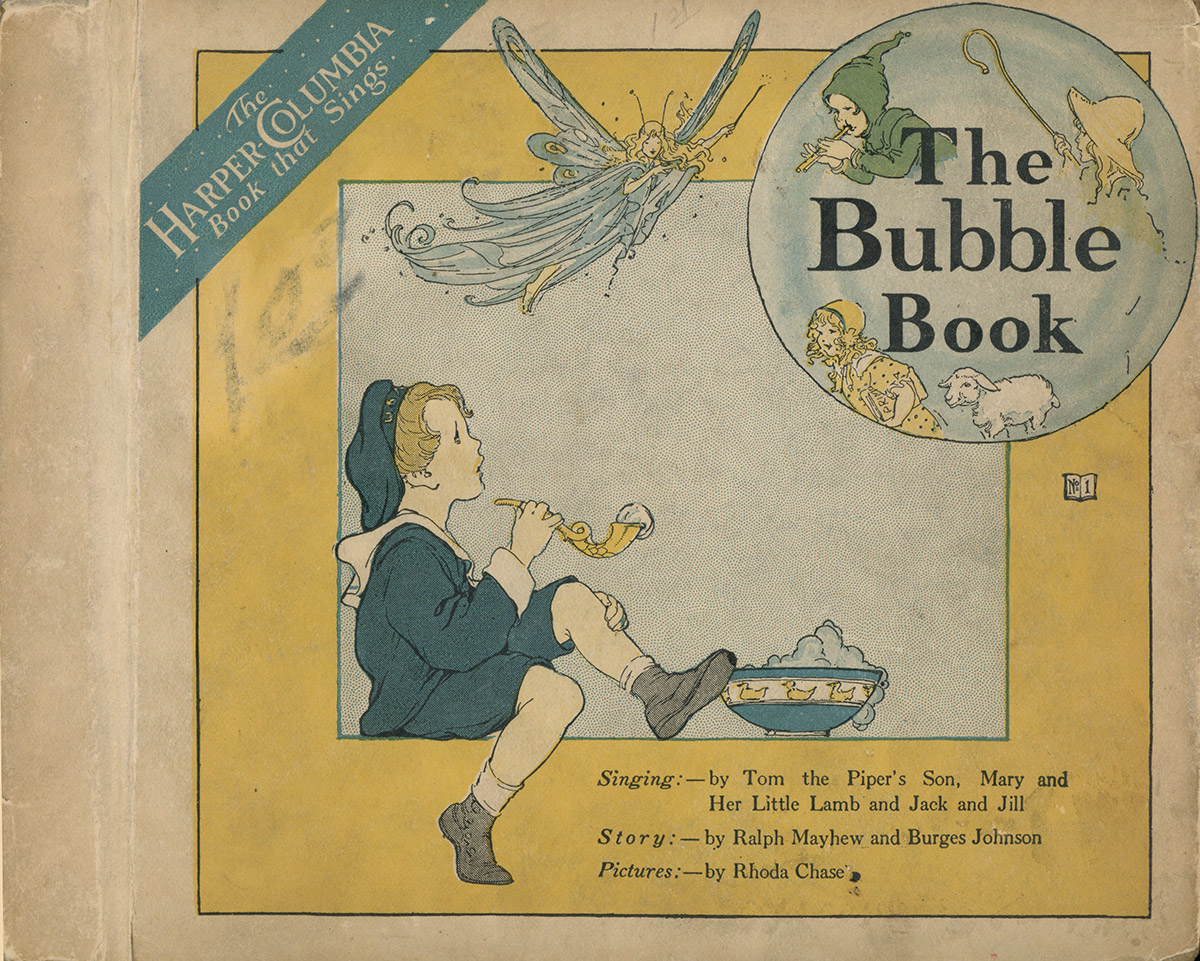
The first foray into recorded children’s literature ventures dates to 1914, when the recording industry was monopolized by Columbia, Thomas Edison, and Victor. Due to the fact that these three companies owned most record-manufacturing patents, records remained relatively expensive at $0.75 to $1.00 per record (approximately $30.00 in 2024 dollars). The music publishing company Waterson, Berlin and Snyder, helmed by Henry Waterson, created Little Wonder Records in 1914 to break the market control of Columbia, Edison, and Victor. Waterson wanted to create smaller records that could be sold more cheaply to a broader consumer base. Serving as a business partner to American composer and lyricist Irving Berlin, Waterson had cut down on the quality of standard records to keep his new records at a lower price point.
The records measured 5 ½ inches with tight grooves on a single side as opposed to then-standard 7-10 inch double-sided records. The tighter groove design was a compromise, offering reduced fidelity and shorter play time (one to two minutes as opposed to the standard two to three) along with cheaper production costs. Additionally the records were not sold with a record sleeve covering. These changes, however, did not stop consumers from purchasing these relatively inexpensive records that were sold for 10 to 20 cents, approximately a 30-90% discount on the prices charged by the Big Three mentioned above. The massive success of these records reduced the price of all records, opening recorded music to consumers once excluded from the medium.

Because Little Wonder was considered a smaller recording label, they did not have the ability to keep up with marketplace demand. In 1917 Columbia had acquired Little Wonder Records back from Waterson and formed a partnership with Harper & Brothers. Columbia had already been familiar with the manufacturing of the records, as Waterson had secretly contacted the company for help when the demand for the records increased exponentially. Under Columbia, Waterson’s innovation in record producing had set forth the idea of integrating written text with audio, which in turn led to the production of fourteen children’s books marketed as the “Bubble Books.” Historically known as the earliest series of books and records advertised towards children, these products were labeled as the “Harper Columbia Books that Sing” and are considered the first product combining the world of book publishing with the then emerging recording industry according to Library of Congress author Cary O’Dell (O’Dell 2003). Unlike the releases by Little Wonder Records, which were meant to be inexpensive records for a general audience, Bubble Books were designed with exclusively children in mind. The idea came to the company’s attention by way of Ralph Mayhew, one of the authors of the books. Mayhew revealed in an interview with Printer’s Ink Magazine in 1921 that he was the one to come up with the idea while trying to come up with ways to popularize the work of author Mark Twain. Mayhew’s idea was to make three-inch phonographic records that would be mounted on a booklet. The records would then play an impersonation of Mark Twain, as if he were reading his own work. After multiple rejections from companies who doubted there would be a market for the records, Mayhew decided to shift his attention to children’s literature, this time conceiving the idea of a children’s book of poetic verses, which had gained interest from his employer at the time, Harpers & Brothers. Slightly departing from his original plan, Mayhew instead came up with the idea of making a series of books with records that sang to the reader. As Mayhew recalls in the interview, the idea suddenly came to him while working on the verses. The plan of incorporating records that would add music to accompany the nursery rhymes struck a chord with him and he immediately patented the idea. After shopping around a mock-up of the proposed book, Harper-Columbia had closed a deal with Mayhew in late fall of 1917 in hopes of the books reaching the market before Christmas. With little time before the proposed launch, Mayhew quickly commissioned illustrator Rhonda Chase to provide artwork for the books and author Burges Johnson to help sharpen Mayhew’s verses. The only issue that remained was finding a facility to assemble the album-book hybrids, as Harper and Brothers did not have one in their arsenal. Mayhew then took it upon himself to call up each album maker in the telephone directory until he found someone who was willing to create the booklets within a reasonable price range.
The records were packaged like books, with a cover and title page, along with fourteen pages displaying an original poem and well-known nursery rhymes. Illustrations by Rhonda Chase were seen throughout and three of the pages in each book doubled as a record sleeve holding the sound disc. The books were sold in book, music, phonograph, and toy stores. Each book held three single-sided 5 ½ inch records and retailed at $1.00 each, following the smaller record format first popularized by Waterson.


Under Columbia the records became a tremendous success. Marketing now to a youthful audience, the story used in the original Bubble Book follows Mayhew’s original story of a lonely little boy clad in blue who was gifted a magical pipe that blows bubbles by his fairy godmother, hence the impetus for the name Bubble Books. The bubbles would come with Mother Goose characters inside that would entertain him with songs and rhymes. The young listeners of the records could sing along with the tunes as they read the story. Ads for the novelty books proclaimed them to have allegedly sold millions. One ad from Dry Goods Economist declared them “the fastest selling merchandise for Child Amusement on the American Market today”, while another ad from Dry Goods Economist dated April 3, 1920 touts, “a million Bubble Books were sold last year through book, music and talking machine stores.”


Although Ralph Mayhew patented the books, Harper & Brothers held the copyright. The innovation of the Bubble Books made the product prosper upon release. They were a perfect amalgamation of innovative novelty and accessibility. By combining emergent media technologies and traditional methods of oral storytelling, this new format struck a chord with listeners nostalgic for familiar nursery rhymes, garnering interest from children and parents alike. Additionally the more efficient production devised by Waterson under Little Wonder had brought down costs across the industry, making this new format more widely accessible. Like Little Wonder Records, the rhymes on the Bubble Books’ discs played for one to two minutes per side. Columbia devised an original marketing campaign, emphasizing the toy-like aspect of Bubble Books, which helped drive up sales. The books were advertised as a way to keep children entertained while moms were busy. Retail advertisements were placed in newspapers, women and children’s magazines, and publications targeting the wealthy. Historian Jacob Smith asserts that these audiobooks were introduced at a time when women’s role in the household was changing. As the role of “mom” became busier and more time-consuming, new ways to amuse and educate children fit an urgent social need. Bubble Books were advertised towards mothers as such. One ad from Ladies Home Journal from March 1920 states, “It Will Keep the Children Busy” in large font underneath an illustrated image of a child handing their mother a Bubble Book. The ad reads; “This mother smiles happily. She can sew or read, without giving a thought to Bobby and Ruth. They no longer get bored and fretful and troublesome with asking ‘Mother, what can I do now’. (see image below) Another ad from Woman’s’ Home Companion (November 1919) uses the same illustrated image, this time reading “..mother smiles happily. She knows this beautiful new toy will fascinate Bobby for hours. She knows it means real joy for him-and long hours of peace and quiet for her.” (see image below). Messages of this nature also pertained to children while retailers were reminded that children were an ample source of income and a rich target for business.
The marketing campaign for the novelty audiobooks also included Bubble Book parties hosted by retailers across the country that featured hired child actors from New York. These events were advertised along with Bubble Book “listening hours” held at various department, phonograph, and book stores. The tremendous success of the initial Bubble Book ushered in thirteen sequels that were produced between 1917 and 1922. As the books sold by the millions, stores that had never carried books or phonographs before were now carrying both, thus further expanding the public’s access to recorded music. In 2004 the Library of Congress had recognized the historical significance of these books by including the first set of Bubble Books into their National Recording Registry, citing its importance in being the first children’s book and record series.



