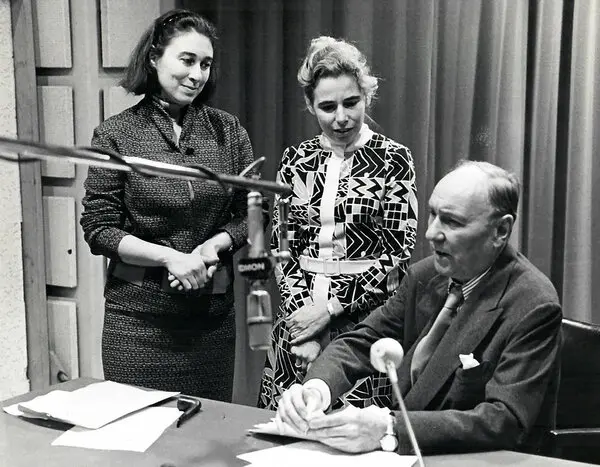
Caedmon Records was founded by best friends and Hunter College undergraduates Barbara Holdridge and Marianne Mantell (née Roney) in 1952. The two women began the business partnership aiming to remediate the work of great living authors through voice recordings. The two believed that the recordings captured the emotion the authors had felt when the work was first written down. In a 2002 article Holdridge reported that Caedmon’s goal was not merely to have a collection of literary voices, but to have the authors and writers “read as though they were recreating the moment of inspiration.” Holdridge states that the authors and voice actors read “with a feeling, an inspiration that came through” (Caedmon: Recreating the moment of inspiration NPR). Mantell later reflected on Caedmon’s origins in similar terms in her Audiofile article detailing her experience of going to American poet Robert Frost’s home to record him in 1956. There Mantell writes that the intention was not to “preserve celebrity voices but to capture on tape as nearly as possible what the poet heard in his head as he wrote.” Thus the slogan of the company had been penned as “a third dimension from the printed page” (Williams). By combining print with voice and feeling, Caedmon Records had established an affinity and space for spoken word recordings, a practice that had now become a staple for the general public as opposed to one specifically catered to the disabled.
In fact, before spoken word recordings became a leisurely activity for literary buffs and busy parents, the concept of an early audiobook was more so an aid to help those experiencing visual impairment. In the late nineteenth century, Thomas Edison had formulated the idea of selling spoken word recordings on tinfoil cylinders. The cylinders came with two needles, one for recording and one for playback. The first recording produced was the child’s nursery rhyme “Mary Had a Little Lamb.” By 1887, Edison had started selling phonographs to the public, marking the beginning of the sound recording industry. By this point Edison had mostly phased out wax cylinders, a more fragile prior format, in favor of discs which were fast becoming the standard (“Saving Our Sounds.”). By 1932 The American Foundation of the Blind had started producing recordings of books on vinyl records with each side containing fifteen minutes of speech. The following year an amendment was passed by Congress to allow the Library of Congress to produce and distribute to the blind. The first records released contained Shakespeare plays, the United States Constitution, and the novel As the Earth Turns by Gladys Hasty Carroll (Thoet) In a sense audiobooks took on the same concept of using audio components to express the visual wording of print but added another dimension to the writing by going deeper into the text and the author’s intentions behind it. When Caedmon had eventually entered the recording business their intentions lay in using sound to create a sensory experience to the reader wishing to experience literature in a modern way (Rubery, “Interview” n.p.), once again referencing the “third dimension to print” synonymous with the company.

The female-owned business had also made sure to place major emphasis on gender equality in Caedmon’s catalog as well, showcasing the work of women writers in an era in which such work lacked prominence in literary culture (“Barbara Holdridge.” Women of the Hall). A recent NPR article detailing the data analysis of the evolution of women in copyright authorship has shown that around 1800 to 1900 the share of female authors in the industry had only managed to roughly make up 10 percent each year. In fact it was only by the late 1960s where female authorship had begun to grow to almost double (Rosalsky). Considering Caedmon’s affinity for recording the work of yesteryear, the decision to specifically look into female writers in order to give them a platform was a valiant decision at the time. Author Matthew Rubery notes, in a 2023 article on Marianne Mantell, that “at the time, only around 5% of record industry employees were women, and those women were almost all in marketing and retail roles. The rise to the top by two female entrepreneurs represented a remarkable exception”. (“Marianne Mantell, N.D.)
The bold endeavors of Holdridge and Mantell had led them to become pioneers in the spoken word literary genre, and historians often credit them as key originators of today’s robust audiobook industry. Having provided an overview of the founding principles of Caedmon, we will take a closer look at the lives of its founders, dynamic women who pioneered a new media form.
Barbara Holdridge was born in 1929 in New York City. In 1950 she graduated from Hunter College with a B.A. concentrated in the Humanities. She briefly continued her education at Columbia University, but by 1952 she devoted her full-time focus to Caedmon. At the time Holdridge had also been working for Liveright Publishers in New York ( Beckerman). Holdridge’s business partner Marianne Mantell was born in Berlin in 1929. After settling in New York in 1941, Mantell went on to graduate from Hunter College with a concentration in Greek. After graduating Mantell started working for a New York recording studio while doing freelance work, translating and composing liner notes on opera librettos on the side (Smith). The two had met at a six week summer Greek class at Hunter, and quickly became friends. Both young women graduated in 1950 and both were members of Phi Beta Kappa, among the most prestigious Greek letter societies in the United States. Two years after graduating the two would collaborate once again (“Barbara Holdridge.”, N.D.). After a failed attempt at convincing record companies to produce poetry recordings, Mantell and Holdridge created Caedmon. The self-made business started off humbly, as Holdridge and Mantell set up a small office in New York, where they would invite authors and poets to read their own works. After finding that their initial plan of recording medieval music and Shakespearean poetry would have no financial backing or interest, they set their sights instead on contemporary authors reading their own work in order to capture the author’s own interpretation and recreation of the emotions felt when the work was first set down. They pooled together $1,800 (about $38,000 in 2024 dollars) to start their own label (Roach), which they named “Caedmon”, after a Northumbrian cowherd known as the earliest English poet (Wachtel). The duo showed great persistence and imagination from the start. To fully make an impact in the then niche market of audiobook recordings, the women knew they had to set their sights on a famed writer that could attract fanfare. At the time Welsh poet Dylan Thomas had been making the rounds, reading his work aloud across college campuses. After multiple attempts to capture the poet’s attention while trailing him on his tour, the founders had finally managed to set up a meeting with Thomas at the Little Shrimp restaurant located in the Chelsea Hotel. After initial skepticism on Thomas’s part, Holdridge and Mantell finally persuaded Thomas to record with a promised paid fee and royalty charge for his work (“Marianne Mantell” N.D.).
The vocally enthralling piece, A Child’s Christmas in Wales, had captivated the founders as Mantell had stated that the recording of the track felt like they were participating “in an event historic in English Literature: the discovery of a genre, literature, that like music, must be performed to achieve its real effect” (Martin). In the years to come Caedmon continued to pioneer this new mode of reading that returned to the origins of oral storytelling. On one end of the spectrum Caedmon had returned to ancient traditions of reading aloud by capitalizing on fairy tales, legends, myths, and other stories that have been passed down for centuries through word of mouth. Rubery cites an example of this targeted marketing when recounting Caedmon’s recording of Oscar Wilde fairy tales: “Everyone who has known the pleasure will we think be delighted with Caedmon’s series of the best of all children’s literature,” touted the album. Other records promised to be substitute readers for parents who might have been too tired to do it themselves (Rubery). Caedmon had promised a sense of intimacy to the listener who would feel as if the story were being read directly to them through the records. In an interview with Rubery, Holdridge states that the audience for the spoken word records were students and teachers in and out of school and people sitting at home. The listeners were ideally those who wished to experience the writings in a new way, any time and any place. The performance of the narrator would bring out the details in the book that could be missed by the human eye when simply scanning the page. Producers added effects, such as sounds and music, that contributed to each original performance and interpretation of a given text. The dramatization of the voices used in Caedmon records was also highly intentional, as Holdridge believed that a neutral reading voice was ludicrous. She believed that the use of italics, ellipses and exclamation points must be showcased in oral performances if used in the print version of the story (Rubery, “Interview” n.p.).
The intentions behind adding performance to voice mirrors the work of Charles Bernstein and Walter Ong. Bernstein, in Close Listening: Poetry and the Performed Word, states that “to be heard, poetry needs to be sounded–whether in a process of active or inactive reading of a work or by the poet in performance. Unsounded poetry remains inert marks on a page, waiting to be able to be called into use by saying, or hearing the words aloud.” (Bernstein) Bernstein argues that poems are understood to be performative events rather than merely printed texts. The oral performance, much like the visualization in its initial printing, makes up both the meaning and existence of the poem. Similarly author Walter Ong makes a case for sound being an important function to print. In his book Orality and Literacy: The Technologizing of the Word, Ong states that written texts, whether directly or indirectly, have to be related to the world of sound: “Reading a text means converting it to sound, aloud or in the imagination, syllable-by-syllable in slow reading or sketchily in the rapid reading common to high-technology cultures.” Bringing together both old and new forms of recitations had allowed Caedmon to create a new wave of media that was considered a viable form of reading. Whether intended to or not, the re-introducing of verbal presentations of stories had ushered in a “secondary orality” different from its predecessor. Although Caedmon had advertised themselves as a company returning to old forms of storytelling, a contemporary lens may see their products as more of a restoration.
Throughout Holdridge and Mantell’s time spent with Caedmon, the women had managed to assemble an eclectic catalog of recordings, ranging from high-brow literature to children’s nursery rhymes and stories. Due to their educational background and interests, the two were well-versed in classic literature and understood the market for it. Although they acknowledge that some of the records sold poorly, they believed their work was contributing to something important and enduring. Holdridge states that their business really began to succeed when President Lyndon Johnson launched Title One of the Elementary and Secondary Education Act in 1965, which spurred a market in which hundreds of records were sold to school systems across the country, attracting large publishers to launch their own spoken word start-ups (Rubery, Untold). Additionally, by making this medium relatively accessible, Holdridge and Mantell took part in the burgeoning “middlebrow” culture of the midcentury US. As discussed in American scholar Joan Shelley Rubin’s book The Making of Middlebrow Culture, Middlebrow sensibility relied on the upper and lower class. Upper consisted of highbrow sponsors such as publishers and museum directors while lower consisted of the audience that participated in highbrow entertainment to create or expand on their intellectual pursuits. Rubin makes reference to the definition of this through American poet and novelist Margaret Widdemer’s essay “Message and Middlebrow” published in the Saturday Review in 1933. Widdemer identified the middlebrow as “the men and women, fairly civilized, fairly literate, who support the critics and lecturers and publishers by purchasing their wares.” Rubin prescribes these efforts as part of the “genteel tradition” where those distinguished with class and sophistication wanted others to engage with said tradition without losing their own persona. In participating in listening to Caedmon’s products, one is impartially submitting to this historical convention. The introduction of middlebrow had created a space for hopeful intellectuals to partake in activity that otherwise may have seemed out of reach otherwise. Due to the record’s accessibility, titles of high-brow literature were made available to the masses. Within the context of children’s audiobooks, the power to now have a performed piece of a beloved tale seemed to be a luxury laced in attainability. Not only did the records promise performances of high art; they also offered convenience for children and parents alike.
By 1966 Caedmon’s achievements and success had garnered a net worth of $14 million and had 36 employees all working in an 8,000 square foot office located in Midtown Manhattan. The work of Caedmon was highly publicized in newspapers and magazines because two young women were running the company (“Barbara Holdridge.”, N.D.). Although resources seemed small, they were made impactful. Aside from poets and authors, Holdridge and Mantell also managed to employ theater and film actors to interpret literary audiobook recordings, and future celebrated stars such as director Mike Nichols and Andy Warhol were hired as workplace colleagues before finding fame later on in their respective film and art careers. This was all due in part to the access the women had gained from studios, artists and designers based in New York. Commissioned work from the artists allowed for the records to stand out through eye-catching cover designs that Holdridge and Mantell had wanted in order for their records to stand out in bookshop windows. During this momentous occasion, Caedmon had gained status as the first company to deal with spoken word recordings at a time where demand for literary recitations had increased. As the label grew, production and studio costs were kept low by doing regular repressing’s (“Caedmon Records.”, NPR). The company was eventually sold in 1970 by a subsidiary of Raytheon called DC Heath and Company where Holdridge remained as president for five years (“Barbara Holdridge.”, N.D.). By 1987 Caedmon was purchased by Harper & Row which we now know as Harper Collins. From 1987 Harper & Row took it upon themselves to repackage and re-release the classic titles produced by Caedmon. The repackaged records came in updated packaging with modern designs and illustrations. The audio itself was also better quality, boasting louder soundtracks and more musical effects (Stewart).

